10 Music School Illustration Assets
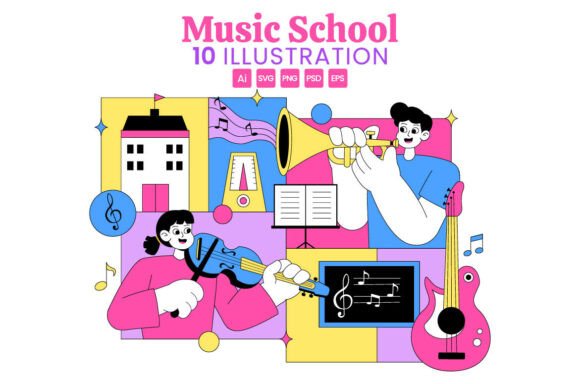
Creating a visual identity for a music education program often feels like trying to capture sound in static ink. You need imagery that conveys rhythm, learning, and performance without cluttering the design with generic stock photos. That is where 10 Music School Illustration steps in as a comprehensive solution for designers who value flexibility and artistic depth. This collection isn't just a set of images; it is a toolkit designed to bring musical concepts to life through vector art that features various musical instruments, dedicated music education learning scenes, and dynamic performance activities by musicians and singers.
Whether you are building a landing page for a new conservatory or designing a brochure for a community choir, the right visual assets can make or break your audience's first impression. The appeal of this specific set lies in its versatility. It moves away from the stiff, corporate look often found in educational materials and embraces a more organic, engaging style suitable for posters, web banners, and digital marketing campaigns. By utilizing these illustrations, you gain access to a cohesive visual language that speaks directly to parents, students, and music enthusiasts alike.
Visual Personality and Artistic Style
The 10 Music School Illustration pack distinguishes itself through a blend of modern typography principles and expressive character design. Unlike a rigid serif font or a sterile sans serif font, these illustrations offer personality. The characters—musicians and singers—are depicted in active poses, suggesting movement and energy. When you look at the various musical instruments included, from grand pianos to acoustic guitars, they are rendered with enough detail to be recognizable but stylized enough to fit seamlessly into different brand identities.
This collection functions similarly to a premium display font in how it commands attention. Just as a well-chosen typeface sets the tone for a document, these illustrations set the emotional tone for a project. The style leans towards contemporary graphic design trends, avoiding the dated clip-art aesthetic. Instead, you get clean lines, vibrant color palettes, and compositions that work well as background templates. The inclusion of layered files means you aren't stuck with a flat image; you have the ability to deconstruct the scene, much like adjusting kerning or leading in modern typography, to create a unique layout that serves your specific narrative.
Where These Assets Shine in Real Projects
The utility of 10 Music School Illustration extends far beyond simple decoration. In the realm of web design, these vectors serve as excellent hero images for landing pages. A large, high-quality illustration of a student playing the violin can immediately communicate the site's purpose better than a block of text ever could. For social media graphics, the transparent PNG versions allow marketers to overlay text, dates, and calls to action without worrying about clashing backgrounds.
In print applications, such as packaging design for music method books or editorial design for school newsletters, the scalability of vector files ensures crisp edges at any size. Imagine a poster series for a summer camp; using the same visual motif across different instruments creates a sense of consistency and professionalism. This is crucial for brand identity. When a parent sees the same style of musician illustration on a flyer, a website, and a t-shirt, it reinforces trust and recognition. It transforms a disjointed set of materials into a unified campaign.
Small business owners and entrepreneurs will find particular value here. If you are launching a startup focused on online music lessons, you don't need to hire a freelance illustrator for every single asset. This collection provides a library of ready-to-use elements that can be customized to match your logo and color scheme. It bridges the gap between expensive custom art and low-quality free resources, offering a middle ground that respects both budget and quality.
Technical Flexibility and Design Workflow
What truly separates 10 Music School Illustration from standard image packs is the technical delivery. The inclusion of fully editable vector files (AI, EPS 10, SVG) gives you complete control over the object, color, and background. This is comparable to having a variable font where you can adjust weights and widths; here, you can adjust the very components of the illustration. If your brand uses a specific shade of teal, you can instantly update the entire scene to match, ensuring perfect color harmony.
The package also includes layered PSD Photoshop files that are non-grouped and unlabeled. While "unlabeled" might sound daunting to a beginner, for an experienced designer, it offers freedom. You can organize layers according to your own workflow preferences rather than fighting against pre-set groups. This level of access allows for complex compositing. Perhaps you only want the singer from one scene and the drum kit from another to create a band setup that doesn't exist in the original file. With these tools, that is entirely possible.
Furthermore, the provision of preview JPEGs and help files streamlines the selection process. You can quickly review the file properties and visual output before committing to a download or purchase decision. The transparent background PNGs are particularly useful for quick turnarounds, allowing you to drop the assets directly into Canva, PowerPoint, or social media scheduling tools without needing advanced software knowledge.
Strategic Considerations for Selection and Use
When integrating 10 Music School Illustration into a project, consider the context of your audience. Are you targeting young children? The bright colors and playful poses might be perfect. Are you aiming for a serious jazz ensemble? You may need to desaturate the colors or pair the illustrations with a more sophisticated handwritten font or a bold creative font to shift the mood. The key is understanding that these assets are a starting point, not a final product.
Evaluating project fit involves looking at the composition. Does the illustration leave enough negative space for your headline? In logo design or banner creation, whitespace is just as important as the content itself. Test different pairings: try placing the illustrations next to different typefaces to see how the visual hierarchy holds up. A heavy, blocky headline might overpower a delicate line drawing, while a light script might get lost against a busy background.
Readability remains paramount. Even though these are illustrations, they function as visual communication. Ensure that the details of the instruments and the expressions of the musicians remain clear when scaled down for mobile devices. The vector nature of the files guarantees sharpness, but the complexity of the scene must still be managed. Sometimes, simplifying the palette or removing minor background elements can improve the overall impact and ensure the message lands effectively.
Finally, always review the commercial licensing terms included in the help file. Understanding what you can and cannot do with these design assets protects your business. Whether you are creating a personal blog post or a national advertising campaign, knowing the scope of your rights prevents legal headaches down the road. With the right approach, 10 Music School Illustration becomes more than just a file download; it becomes a foundational element of a successful, visually compelling music education brand.