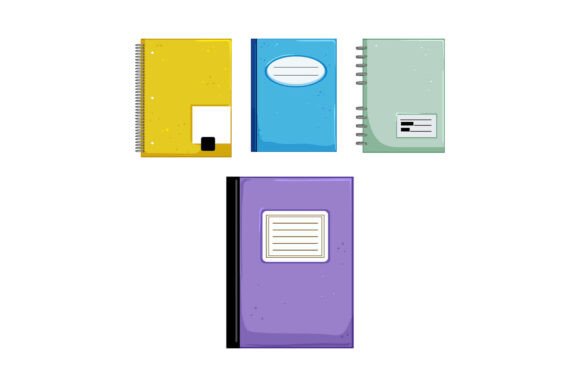
Collection of Notebooks for Education and Professional Organization
In the landscape of analog productivity, a Collection of Notebooks for Education and Professional Organization represents more than just a stack of paper; it signifies a deliberate approach to information management. For adults navigating complex workloads, academic pursuits, or creative projects, the choice of writing instrument is often secondary to the vessel that holds the thoughts. This collection typically features an assortment of colorful school and office notebooks, ranging from durable spiral designs to sleek bound formats, all unified by blank labels ready for customization. Unlike generic stationery found in bulk bins, these curated sets are designed to support distinct cognitive workflows, offering a tactile alternative to the fleeting nature of digital notes.
The distinction of this specific collection lies in its versatility and modularity. By combining varied binding styles with uniform aesthetic potential through blank labels, it addresses the dual needs of portability and archival stability. Whether a user requires the lay-flat convenience of a spiral notebook for sketching diagrams or the professional finish of a hardbound journal for client meetings, this assortment provides a cohesive system. The inclusion of vibrant colors serves a functional purpose beyond aesthetics; color-coding allows for rapid visual sorting of subjects, departments, or project phases, reducing cognitive load when retrieving specific information later.
Evaluating Binding Styles: Spiral vs. Bound Designs
When assessing the components within a Collection of Notebooks for Education and Professional Organization, the binding mechanism is the primary factor influencing usability. The decision between spiral-bound and hardbound or softbound options is rarely about preference alone; it is a calculation of context and physical utility.
Spiral-bound notebooks offer superior flexibility. The metal or plastic coil allows the pages to rotate 360 degrees, enabling the notebook to lie completely flat on a desk or lap. This feature is critical for users who engage in extensive diagramming, graphing, or writing across page spreads without fighting the spine. For students in STEM fields or professionals drafting architectural sketches, the spiral design minimizes the "spine gap" that can obscure content near the center fold. However, the tradeoff is durability. Over time, spirals can snag on clothing, break under stress, or rust if exposed to moisture. They also tend to feel less formal in high-stakes business environments.
Conversely, bound designs, whether hardcover or softcover with glued spines, offer a streamlined profile. These notebooks fit easily into briefcases, laptop bags, and pockets without the risk of coils catching on zippers or fabric. The rigid structure of a hardbound option protects the interior pages from bending and creasing, making them ideal for long-term archival purposes. A bound notebook conveys a sense of permanence and professionalism, suitable for executive summaries or formal records. The limitation, however, is the inability to lay the book perfectly flat, which can make writing in the inner margins difficult without manual manipulation.
A balanced approach often involves utilizing both types within the same collection. One might employ spiral notebooks for active brainstorming, field notes, and rough drafts where flexibility is paramount, while reserving bound notebooks for finalized reports, meeting minutes, and reference materials that require longevity and a polished appearance.
The Role of Blank Labels in Customization
A defining characteristic of this educational and office assortment is the inclusion of blank labels on the covers. In a world of pre-printed categories like "Math," "History," or "Project X," blank labels offer a dynamic advantage: adaptability. As roles evolve and priorities shift, the function of a notebook must be able to change without requiring the purchase of new supplies.
This feature supports a personalized organization system. An adult learner might label one notebook "Q3 Strategy" and repurpose it six months later as "Annual Review." Similarly, a student transitioning from undergraduate studies to graduate research can re-label existing stock to match new course codes. The ability to write directly on the cover facilitates immediate identification, eliminating the need to flip through pages to verify content. It encourages a mental model where the tool adapts to the user's current reality rather than forcing the user to conform to a pre-set category.
Furthermore, the act of labeling itself reinforces memory retention. Writing the title of a subject or project by hand creates a stronger neural association than simply selecting a pre-printed icon. When combined with the variety of colors available in the collection, blank labels enable a sophisticated color-coding strategy. For instance, blue covers could denote administrative tasks, red for urgent deadlines, and green for creative development, allowing a user to scan their desk and instantly understand the status of their workload.
Comparing Analog Collections to Digital Alternatives
While digital note-taking applications have gained immense popularity, the Collection of Notebooks for Education and Professional Organization retains unique advantages that software cannot replicate. The comparison between analog and digital tools often centers on distraction management, memory retention, and data security.
Digital tools excel at searchability, editing, and cloud synchronization. If a user needs to find a specific phrase written three years ago or share a document instantly with a remote team, a tablet or laptop is the superior choice. However, the very connectivity that makes digital devices powerful also introduces friction. Notifications, emails, and the temptation to multitask can fragment attention. A physical notebook demands singular focus; there are no pop-ups, only the pen and the page.
Research consistently suggests that handwriting notes leads to better comprehension and recall compared to typing. The slower pace of writing forces the brain to process and summarize information in real-time, rather than transcribing verbatim. This cognitive engagement is particularly valuable for education and strategic planning. Additionally, physical notebooks offer absolute privacy. There is no risk of hacking, server outages, or subscription fees expiring. The information exists solely in the hands of the owner, providing a sense of security that is increasingly rare in a digitized world.
That said, the limitations of the analog approach are clear. Physical notebooks cannot be searched with a keyword command, they take up physical space, and they are susceptible to damage from fire, water, or loss. Therefore, the right choice depends on the nature of the task. For transient data, quick lists, or collaborative documents, digital tools may be preferable. For deep thinking, complex problem-solving, and long-term knowledge building, the tactile reliability of a curated notebook collection remains unmatched.
Decision Factors for Selecting the Right Format
Choosing the appropriate items from an assortment of school and office notebooks requires evaluating specific use cases. There is no single "best" notebook for every scenario. Instead, the decision should be driven by the environment, the duration of the project, and the type of content being generated.
- Portability Requirements: If the user travels frequently or commutes daily, smaller, lightweight spiral notebooks with blank labels are ideal. They fit into messenger bags and backpacks without adding significant weight. Larger bound volumes are better suited for stationary desks or home offices.
- Content Type: For heavy mathematical work, engineering drawings, or artistic sketching, the lay-flat capability of spiral bindings is non-negotiable. For text-heavy writing, journaling, or formal record-keeping, bound notebooks provide a smoother surface and a more elegant presentation.
- Longevity Needs: If the notes are intended to last for decades, such as family histories or permanent business records, high-quality bound notebooks with acid-free paper are the prudent choice. Spiral notebooks are better for temporary working files that will eventually be discarded or digitized.
- Organization Style: Users who thrive on visual systems will benefit most from the colorful assortments. Those who prefer minimalism might opt for a monochromatic set, using the blank labels to create a clean, uniform look.
It is also important to consider the paper quality within the collection. Thin paper may bleed through when used with fountain pens or markers, ruining the opposite page. A robust selection will include varying weights to accommodate different writing instruments. For those who switch between ballpoint, gel, and marker pens, having a mix of paper densities ensures that the writing experience remains consistent regardless of the tool used.
When to Choose Another Option
Despite the benefits of a curated Collection of Notebooks for Education and Professional Organization, there are scenarios where other resources may be more effective. If a project requires frequent collaboration among multiple team members in different locations, a shared digital whiteboard or cloud-based document platform is essential. Physical notebooks cannot be edited simultaneously by two people, nor can they be updated remotely.
Additionally, for users with specific accessibility needs, such as visual impairments that require screen readers or magnification software, digital formats offer necessary assistive technologies that paper cannot provide. In these cases, the tactile nature of the notebook becomes a barrier rather than a benefit.
Finally, cost-effectiveness plays a role. While a diverse collection offers variety, purchasing individual specialized notebooks for every niche task can become expensive over time. For budget-conscious individuals or large organizations with hundreds of employees, standardized bulk purchases of a single format might be more economical, even if they lack the aesthetic appeal or functional diversity of a curated assortment.
Ultimately, the value of this collection lies in its capacity to bridge the gap between casual note-taking and structured documentation. By offering a range of binding styles, colors, and customizable labels, it empowers users to construct a writing system that aligns with their personal workflow. Whether for a student organizing semester notes or a professional managing complex projects, the right notebook acts as a silent partner in the pursuit of clarity and organization. The decision to invest in such a collection is an investment in a focused, intentional approach to capturing ideas in a world that is constantly moving faster.