Nurturing Early Literacy: The Visual Power of a Boy with Teacher Learn English Alphabet
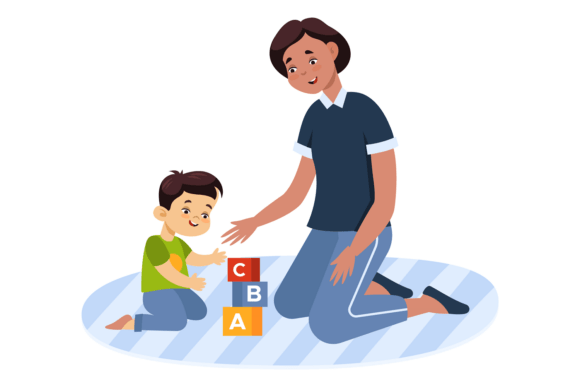
In the evolving landscape of early childhood development, the visual representation of learning moments plays a pivotal role in how educators, parents, and content creators communicate educational value. A specific yet powerful image often captures this essence: a Boy with Teacher Learn English Alphabet. This scene, typically depicted as a young child sitting on a carpet with an instructor, using colorful cubes to master the letters of the English language, transcends mere illustration. It serves as a foundational symbol for preschool education concepts, home schooling initiatives, and the broader philosophy of interactive literacy.
Whether viewed as a vector cartoon in flat style or a high-resolution JPG for digital marketing, this imagery encapsulates the transition from passive observation to active engagement. For professionals in the education sector, understanding the nuances of such visuals is crucial for curriculum design, while for business owners and creators, it represents a key asset in communicating trust and pedagogical soundness. The dynamic between the student and the mentor, set against the backdrop of a comfortable home environment, offers a rich narrative about modern learning strategies.
The Pedagogical Significance of Tactile Learning Tools
At the heart of the scenario where a boy uses cubes to learn the alphabet lies a well-established educational principle: tactile learning. Unlike traditional rote memorization, which relies heavily on auditory repetition and visual flashcards, the use of physical objects like letter cubes engages multiple senses simultaneously. When a child manipulates a cube bearing the letter "A," they are not just seeing the shape; they are feeling its texture, weight, and form. This multisensory approach strengthens neural pathways associated with memory retention.
In the context of a Boy with Teacher Learn English Alphabet, the cubes act as concrete anchors for abstract concepts. The alphabet is inherently symbolic, but for a kindergartener, symbols can be elusive. By assigning a physical object to each letter, the teacher transforms an abstract task into a tangible game. This method aligns with Montessori and other progressive educational frameworks that emphasize hands-on exploration. The isolation of these elements in a vector illustration—often showing the cubes clearly separated from background clutter—mirrors the cognitive clarity the child achieves when focusing on one letter at a time.
Furthermore, the arrangement of these cubes allows for the introduction of phonics and word building. As the lesson progresses, the boy might arrange cubes to spell simple words, bridging the gap between individual letters and meaningful communication. This progression is critical in preschool education, as it lays the groundwork for reading fluency. The visual depiction of this activity highlights the collaborative nature of the learning process, where the teacher guides rather than dictates, fostering independence and problem-solving skills.
Advantages of Home-Based Educational Environments
The setting of the illustration—a cozy home with a carpeted floor—introduces another layer of significance: the shift towards home-based education. In recent years, the concept of the classroom has expanded beyond four walls to include living rooms, bedrooms, and play areas. This shift is driven by a desire for personalized attention and a flexible schedule, particularly evident in the wake of global changes to schooling systems.
When a Boy with Teacher Learn English Alphabet is depicted sitting on a carpet, it signals a departure from rigid desk-bound instruction. The carpet represents a safe, soft, and inviting space where mistakes are part of the journey. In a home environment, the power dynamic between teacher and student often shifts towards a more familial and supportive relationship. This comfort level can reduce anxiety in young learners, allowing them to take risks in their pronunciation and spelling without fear of judgment.
For parents acting as primary educators or hiring private tutors, this setup offers practical advantages. It eliminates commute times, reduces exposure to large group illnesses, and allows for customized pacing. The visual of the child and teacher on the floor suggests a partnership where the adult meets the child at their literal and figurative eye level. This proximity fosters better communication and emotional bonding, which are essential components of effective early childhood education. The isolated nature of the illustration emphasizes this intimate connection, stripping away distractions to focus purely on the educational exchange.
Visual Communication in Educational Marketing and Content Creation
Beyond the classroom, the imagery of a boy learning with cubes serves as a potent tool for content creators, businesses, and researchers. In the digital age, visual assets must convey complex messages instantly. A vector cartoon in a flat style, featuring a Boy with Teacher Learn English Alphabet, provides a clean, scalable solution for various media platforms. From website banners to social media posts, this type of illustration communicates professionalism, clarity, and a child-centric approach.
The choice of a flat style vector is deliberate. Flat design removes unnecessary gradients and shadows, ensuring that the core message—the interaction between the learner and the material—is immediately apparent. This aesthetic is particularly popular among tech-savvy educators and startups in the EdTech sector. It appeals to a broad audience, including consumers looking for tutoring services, app developers designing literacy games, and publishers creating digital workbooks. The simplicity of the style ensures that the image remains legible even on small mobile screens, a critical factor in today's mobile-first consumption habits.
Moreover, the versatility of such illustrations allows for extensive customization. Creators can adapt the skin tones, clothing styles, and cube colors to reflect diverse cultural backgrounds, promoting inclusivity in educational materials. The ability to isolate the characters and objects (EPS format) means that designers can integrate these elements into larger compositions, such as infographics explaining the benefits of early literacy or brochures for preschool programs. This flexibility makes the image a valuable asset for anyone aiming to demonstrate expertise in early childhood development.
Implementing Interactive Lessons in Preschool Curricula
For educators and curriculum designers, the workflow suggested by this imagery offers a blueprint for implementing interactive lessons. The scenario of sitting on a carpet with cubes is not merely a static pose but a representation of a dynamic lesson plan. To replicate this success in real-world settings, teachers must consider the spatial arrangement, the selection of materials, and the pacing of the activity.
A successful implementation begins with preparation. The cubes should be durable, easy to grip, and feature clear, high-contrast lettering. The carpet area must be defined, perhaps with a rug that delineates the "learning zone" within a larger room. During the lesson, the teacher initiates the activity by demonstrating how to hold and identify a cube, then invites the boy to participate. This scaffolding technique ensures that the child feels supported while gradually taking ownership of the learning process.
Observation is key in this workflow. Educators watch for signs of engagement, frustration, or confusion. If the boy struggles with a specific letter, the teacher can pivot, using the cubes to create patterns or sounds related to that letter. This adaptability is a hallmark of effective preschool education. The visual of the Boy with Teacher Learn English Alphabet captures this moment of guided discovery, reminding practitioners that the goal is not just to teach letters, but to cultivate a love for learning.
Additionally, this approach can be integrated into broader thematic units. For instance, if the class is studying animals, the cubes can be used to spell out names of animals, linking literacy with science. The versatility of the cubes allows for endless variations, keeping the lessons fresh and engaging. By grounding the curriculum in physical manipulation, educators can address different learning styles, ensuring that kinesthetic learners thrive alongside visual and auditory learners.
Cultural and Developmental Implications of Shared Learning
The image of a boy and teacher sharing a learning moment also carries profound cultural and developmental implications. In many societies, the transmission of knowledge is deeply rooted in communal and relational contexts. The depiction of a one-on-one interaction underscores the importance of mentorship and the human element in education. Even as technology advances, the need for human connection in early learning remains paramount.
From a developmental perspective, the social interaction inherent in this scenario supports language acquisition. Language is not learned in isolation; it is acquired through dialogue, turn-taking, and shared reference points. As the teacher and boy discuss the cubes, they engage in conversational routines that build vocabulary and grammatical understanding. The teacher models correct pronunciation and usage, while the boy practices in a low-stakes environment. This social scaffolding is critical for developing not only literacy but also social-emotional skills.
Furthermore, the image challenges traditional notions of formal schooling. It suggests that learning can happen anywhere, anytime, provided there is the right guidance and resources. This democratization of education is empowering for families who may not have access to high-quality preschool facilities. It validates the efforts of parents and community members who strive to provide enriching experiences for their children. The visual narrative reinforces the idea that every child deserves the opportunity to explore the world of letters and words in a supportive, nurturing environment.
Future Trends in Early Childhood Visual Assets
Looking ahead, the demand for high-quality, semantically rich visual assets like the Boy with Teacher Learn English Alphabet is expected to grow. As the EdTech industry expands, there will be an increasing need for illustrations that accurately reflect modern pedagogical practices. Future trends may see a greater emphasis on diversity, inclusion, and the integration of technology within these scenes. For example, we might see illustrations where physical cubes interact with augmented reality apps, blending the tactile with the digital.
However, the core principles will remain unchanged. The focus on active engagement, the importance of the teacher-student relationship, and the value of a comfortable learning environment will continue to define effective early childhood education. Whether rendered as a vector EPS file for print or a JPG for web use, these images serve as enduring reminders of the fundamental human desire to learn and share knowledge. They capture a fleeting moment of discovery that resonates with educators, parents, and children alike, bridging the gap between theory and practice in the pursuit of literacy.
Ultimately, the story told by a boy sitting on a carpet with his teacher and a set of alphabet cubes is a universal one. It speaks to the potential of every child and the dedication of those who guide them. By embracing the characteristics, advantages, and applications of this learning model, stakeholders across the education spectrum can foster a generation of confident, capable readers ready to navigate an increasingly complex world.